
Well gang, we have our first Expansion in Second Edition. This came with a new two-sided board that includes a new hex type, as well as new feature tokens the players place after they’re done placing Treasure tokens. Let’s look at each change in turn, then cover implications for competitive play.
Thank you to Games Workshop for providing the page with an advance copy of this product for review and content creation.
Spitewood Rules Updates
The only changes to the rules involve the new hex types and tokens, which we’ll get into soon. There was no segment in the book about Core Rules besides a reference page, and there are no changes there that I could see. That means we continue to follow the ‘new’ board setup rules from the last FaQ/Rules Update. The rest of the Spitewood Pamphlet, while pretty, is mostly fluff/lore and the like, and you didn’t click on this specific article to hear that.
Spitewood Tokens and Hex Type Additions
Waystone Hexes
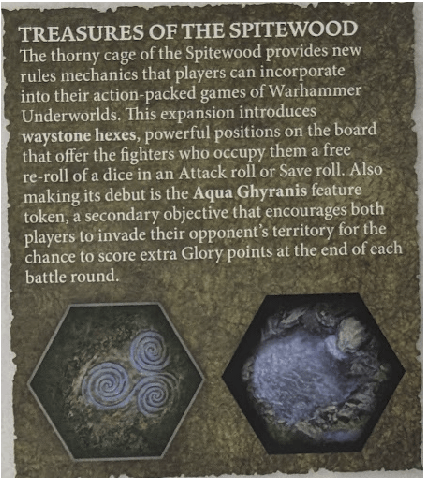
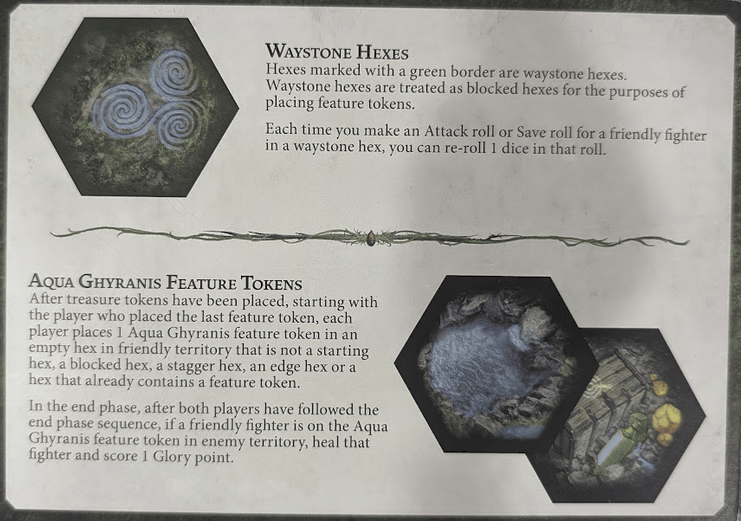
Waystone Hexes are present as printed hexes on the new Spitewood board, which you can see in the next section. Per the promo article, “Waystone hexes are sanctified ground that let you re-roll one dice in an Attack or Save roll, both rewarding careful positioning in the Spitewood.” No matter which of the Spitewood board sides you take and regardless of the orientation you choose, each player will have the same number in their territory: either 1 or 2. Neutral territory will never have a Waystone Hex.
Warbands with ranged attacks may appreciate these as they’re able to reroll attacks regardless of where they are attacking into and will get the reroll on saves if anybody tries to knock them from their turret perch. Aggro/Strike invading teams may benefit from this as well should they be able to land in one in enemy territory to get busy slaying.
These count as Blocked hexes for the purposes of Feature Token placement, so you cannot put a Treasure/feature in a Waystone Hex. This is almost assuredly a good thing, though it could make placement a little crowded on some boards.
These only exist on the new board, so depending on whether you want them or want to avoid them, you may need to weigh this when you win the opening roll-off to select the boards. We will talk more about this in the boards section below.
Aqua Ghyranis Feature Tokens
After you’re done placing Treasure tokens, each player will place 1 Aqua Ghyranis feature token (which DOES count as a feature token for rules purposes). While the ‘Treasures of Spitewood’ text box suggests players ‘can’ incorporate these feature tokens, it doesn’t specify the details. Do both players have to agree? Hopefully this gets an early FaQ, and if not, you’ll want to check with a T.O. before any major event (like, you know, the World Championships…)
The token you place must go in an empty hex in friendly territory. It can’t be a Stagger, Starting, Edge, or Blocked hex. Since Waystones count as blocked for this step, you can’t double up here.
From that point on, the Aqua Ghyranis in your territory does nothing for you. The one your opponent placed in their territory, however, can grant you benefits. Stand on it in an end phase, and after scoring, discarding, applying upgrades, and drawing new cards is complete, you’ll heal the fighter and gain a glory point.
Healing is great for elites and large fighters, glory is great for everybody. You can’t use this glory to buy anything in the end phase, and your fighters will still be damaged when the objective scoring is happening, but it’s something to keep in mind!
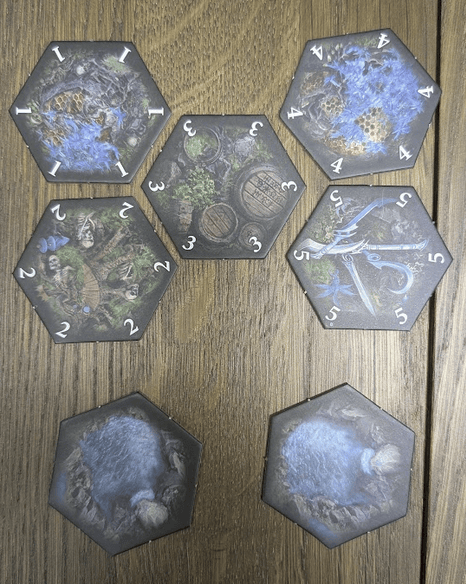
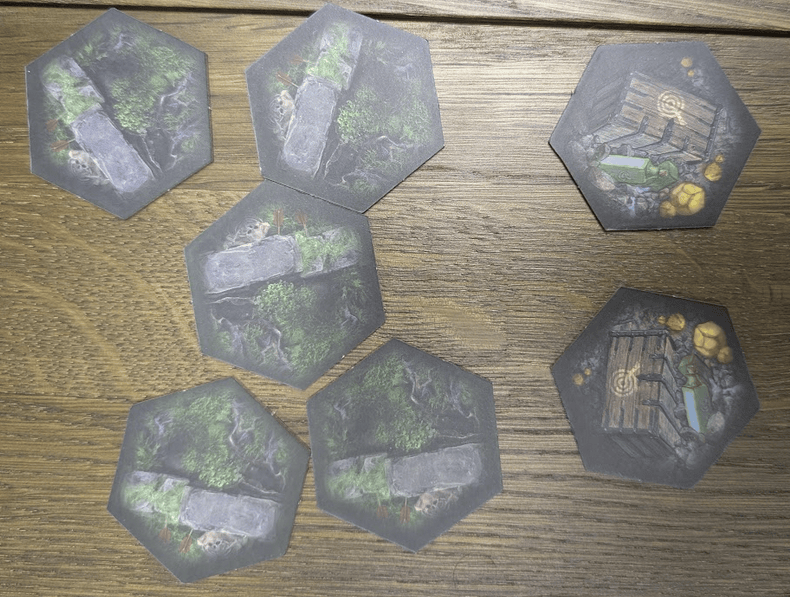
Below are photos of the new tokens.The back of an Aqua Ghyranis Token is just alt-art Aqua Ghyranis, and they’re not specified as able to be delved. One side is a pool of water for playing on the Spitewood boards, and the other is a crate full of water bottles for the Embergard board.
Spitewood: The Board(s)
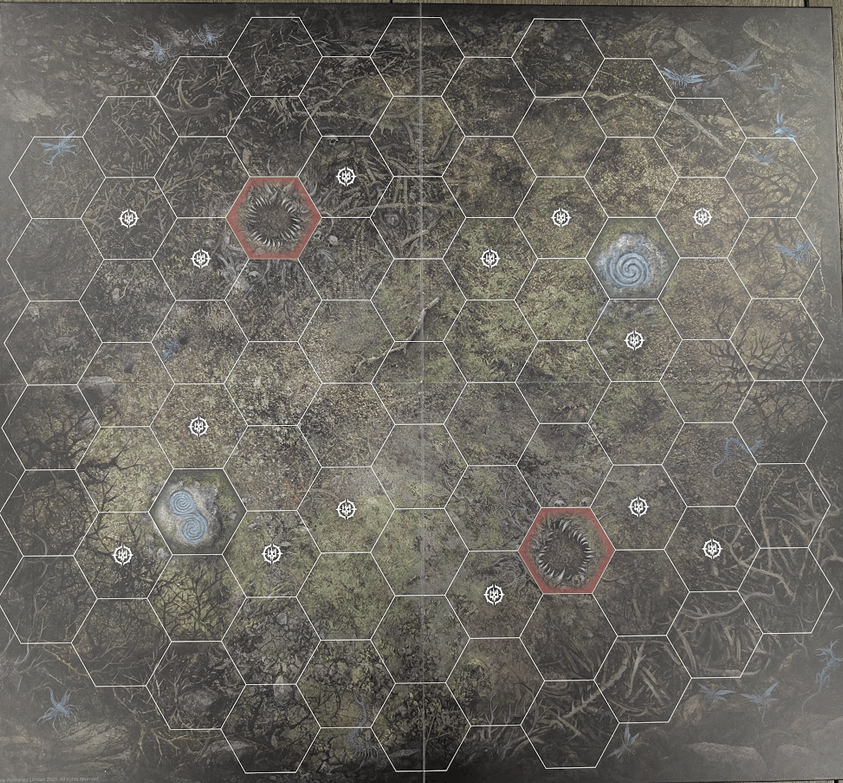
For now I’ll call this “Board 1” since it has 1 Waystone per territory. With 1 Stagger Hex and 1 Waystone Hex per side regardless of orientation, this will look closer to what we have been used in in Embergard.
Board 1 has an interesting feature: it is rife with adjacent starting hexes – no matter how it is oriented, both players will have two pairs of adjacent starting hexes. This will be helpful for those who would like to use those to score cards, trigger warscroll abilities, or benefit from the United status when playing the new Deadly Synergies deck.
The waystone hexes here are also interestingly placed – both of them have three starting hexes around them, so depending on your warband you may be forced to deploy next to one and give your opponent a prime landing spot for their opening charge. 3 and 4-fighter bands can avoid this issue, though they may be charging into a flanked or surrounded scenario to achieve this.
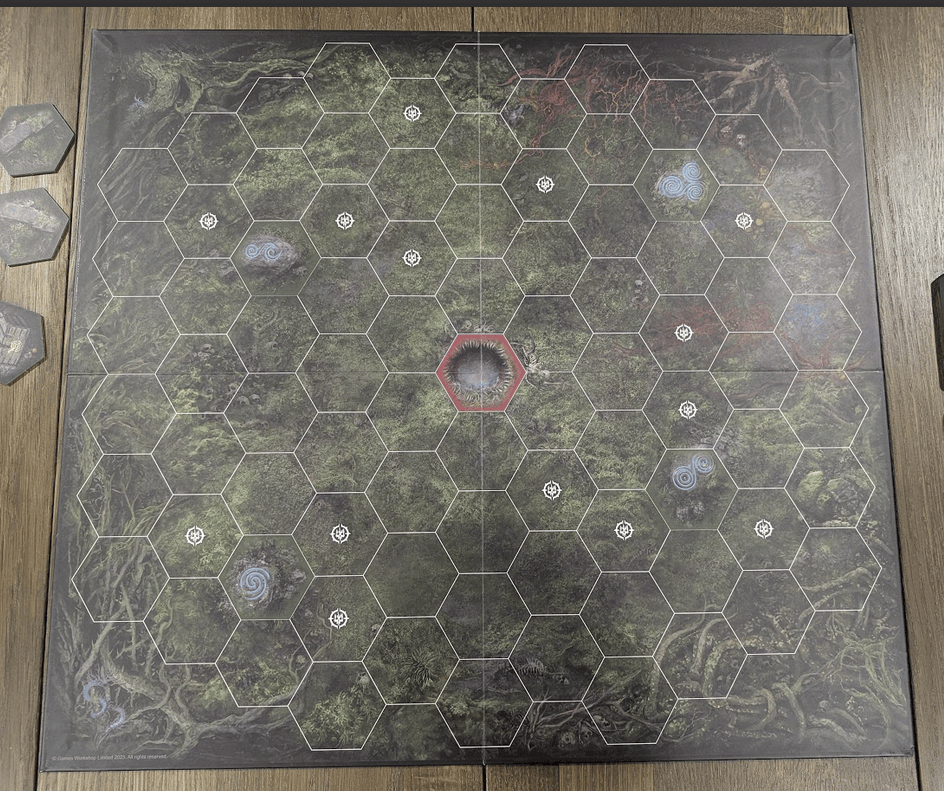
Taking a look at “Board 2”, we see one central Stagger with 2 Waystone Hexes per side. Warbands who think they’ll be in more need of or better able to leverage Waystone will like this board. Having only the one Stagger hex dead in the center can benefit some warbands who really don’t want to get drive back into one – there are no Starting hexes adjacent to it. Additionally, not having one in the player territories presents potential counters to Pillage teleports, Cataclysm’s Sudden Blast, and any subsequent power cards that deal with Stagger Hexes.
Board 2 is also loaded up with adjacent starting hexes, though not as much as Board 1. In one orientation, both players will have two pairs of adjacent hexes, and in the other, one player gets two pairs while the other has only 1. If you’re facing Deadly Synergies or a warband that enjoys adjacency for warscroll options, you may want to take Board 2 and give them that orientation to limit their choices. But what happened to that secondpair of adjacent hexes? Well let’s look at an underworlds first: adjacent enemies during deployment.
Board 2 allows for two adjacent starting hexes in two different players’ territories. If you deploy in the bottom half of this board and give your opponent top half, there’s a chance (or a guarantee, in the case of 7-fighter hordes) you could set up an immediate adjacency and be able to attack from range 1 without charging or pushing.
One of the Waystone hexes on Board 2 is flanked by only a single starting hex, so if you have a move 4+ fighter, you’ll be able to charge into that Waystone hex, get a reroll off the rip, and not even be flanked when you make your attack rolls.
The last little nugget I noticed on Board 2 is that it does have a relatively ‘safe’ deployment hexes. With somewhat of a ‘dead zone’ on the left-middle section of the board above, you can get a scenario where a starting hex is 4 or even 5 hexes away from the nearest enemy deployment. If you have a critical fighter who MUST survive the opening activations, Board 2 gives you a place to hide them.

Notably there are no blocked hexes on either side of this board.
Implications for Competitive Play
Second edition has been marked by ‘lower lethality’ compared to first edition, and time will tell whether these new hex types move the needle on this. On one hand, rerolls on attacks will boost accuracy, but rerolls on defense will improve survivability. I haven’t done the math, but I imagine the attacker benefits slightly more than the defender with regard to Waystone hexes, though warbands with additional pushes and moves may have a better time getting onto them. Two-dodge mobility hordes like Thorns of the Briar Queen may be pretty hard to shift when playing on Spitewood boards. High-damage, low-accuracy teams (especially with range 2 melee) such as Gorechosen might feast with those rerolls though, so it could go either way. If you’re playing on the Spitewood boards, you really will have to pay attention to them, and depending on your matchup you might be more inclined to choose the side with 4 Waystones or opt for an Embergard board to deny your opponent the benefit.
Treasure token placement could get a little crowded with Waystones counting as Blocked for that phase. Canny players will be able to use these to better ‘zone out’ their opponents. Winning the board roll, and therefore ‘losing’ the treasure token game probably still hurts warbands that want treasure in their territory – though you could opt for taking Board 2 and potentially force a 2-1-2 situation if you play it right.
When placing your Aqua Ghyranis feature, you’ll have a lot to think about too. It’s yet one more thing you’ll have to think about controlling or denying. Can you afford to let your opponent sit on it, heal, and gain a glory? If they’re on one, they’re not on a treasure or waystone hex though, which might be better for you in the long run. Do you drop yours near the back to make it harder to reach, or do you leave it in the front so you can hit people as they step onto it? Do you put it somewhere you want to stand so you can occupy it and deny it to your opponent? Do you risk giving them a chance to overrun onto it and get even more benefits for swinging at you than usual?

At the end of the Embergard meta, swarming hordes had a distinct advantage, and elite aggro was doing worse. Waystones probably help those Elite aggro teams, though the Aqua Ghyranis probably helps the hordes more. Which one will see more benefit and how the balance will tip will unfold in time, but right now it looks like anyone’s game. If I were a gambling man (I’m not, gambling is bad) I would still lean towards high-mobility hordes, as there are even more important places on the board to stand, so the more fighters you have to occupy them the better. Bonus points if you have multi-pushes and bonus move actions to spread out and grab as many special spots as possible before your opponent can.
In Practice
I played a handful of test games using the new boards and token rules, and I do have to say I was pleasantly surprised. While I didn’t find Waystone hexes made a huge difference, the Aqua Ghyranis tokens really did affect the shape of the game. It was rare for an important situation to take place in a waystone hex, as I was usually trying to stay away from them so as not to invite a reroll situation for the opposing warband. It was nice to have another thing on the board to play around.
Aqua Ghyranis, on the other hand, did make a real difference in a few games. I would find myself with my fourth activation saying ‘do I gamble on hitting this surge, or do I take the guaranteed glory?’ It created so many more decision points both offensively and defensively, and while it might muddy some competitive scenarios like Primacy did way back in the day with bonus glory out of nowhere, it felt so much better than primacy did because it was symmetrical and not as biased on some warbands’ favor.
Also, it was nice to have some visual differences. I really appreciate how green and pretty Board #2 was (my photo does not capture this very well), and having the stagger token exactly in the middle also changed several play patterns. Overall, this should make things more engaging and varied, and I’m glad for all of these differences so far!
Wrap
What do you think? How does this new ruleset change the shape of the game for your favorite deck/warband, and how will it shift the meta? I’d love to hear your thoughts at SpentGlory@gmail.com and for the first time, I hope you enjoy Spending your Glory (and earing some with Aqua Ghyranis) in the tangled roots of the Spitewood.
Be sure to check out Spent Glory’s other review articles here

Thanks again to Games Workshop for providing me with this product so that I can produce this review content.



 Spent Glory
Leave a comment