

Today’s post will be a guided way to learn the core rules of Warhammer Underworlds’ Second Edition and will slot into the New Player Series.
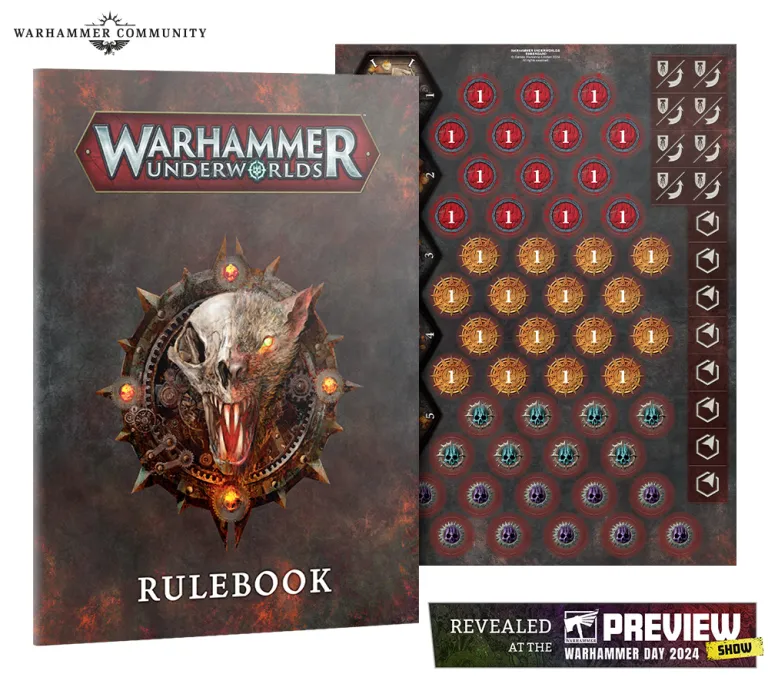
Throughout this article, we will be referring to the Embergard Core Rulebook, which you can read in full online for free by clicking here.
Several members of my local play group in the Seattle Area have a background in Education, and as such they’ve cooked up a stepwise tool: a set of questions for newer players learning the rules. I’ve been asked not to credit individuals, but just know that Dr Fishmode had very little to do with putting this together and mostly served as a copy editor (my weakest skill)
If you’ve already played a handful of games, many of these may be things you already know, but others might be things you’ve forgotten (or have been playing wrong!). If you’re brand new at the game, this is an awesome tool for working through the rulebook one piece at a time and making sure you get the important information; think of it as a study guide. Hopefully this helps onboard new players a little easier and helps old-timers review for cleaner games.
Getting Started
- What is the primary way players win a game of Warhammer Underworlds? (minor victories and draws discussed later)
- What ‘components’ together are collectively called a warband?
- What is a warscroll and what are fighter cards?
- How many different sections (or aspects) of a warscroll can you name (i.e. inspire section tells you…)
- What are runemarks?
- What are the five different symbols on the dice? What symbol in duplicated?
- What are the three types of territories on the battlefield?
- How many hexes form neutral territory? (Kind of a trick question)
- In addition to the empty hex type, what are the other four types of hexes found on the game board?
- What do you do when a fighter meets their Inspire condition (or uninspired condition)?
- What information does a fighter card provide about a fighter? Specifically what are the four fighter characteristics? What are the five weapon characteristics?
- In a Rivals deck, what are the yellow cards and red cards called?
- What are the two types of Objective Cards? What are the two types of Power cards?
- How many surge objective, end of turn objective, ploys, and upgrades are in a Rivals Deck?
- How many Rivals Decks are there currently? Bonus points: can you name and their general theme for scoring? (Check your work at the Rivals Deck Master List)
- When can a Surge ability be played? Must you play a surge card (i.e. think difference between objective cards and power cards)?
- Is there an odd moment when a surge objective card surge objective is playable, but cannot yet be played? (Tricky! pg. 17)
- What do you do after scoring a Surge Objective card?
- If a player has multiple abilities resolving at the same time, who chooses their order? If multiple players? (pg. 17)
- If a card ability contradicts the rulebook, which takes precedence?

Setting up
- During the Muster Warbands step, (i.e. before the game starts) what must a player have ready in order to play Underworlds?
- What is a best practice to place next to warband abilities on the warscroll? Why?
- How many Objective cards and Power cards form a player’s starting hand?
- How does a “redraw” (i.e. mulligan) work? Do you redraw just power cards, just objective cards, or both? (Review strategies for this step in the Contender Series)
- In a roll-off, what is the rank of each symbol? What happens on a tie?
- How is the board position determined? Who decides the position? (Review strategies for this step in the Contender Series)
- Who places the first and following feature tokens? How are feature tokens oriented when initially placed on the board and why? Bonus: How has this rule been revised? (Review strategies for this step in the Contender Series)
- What are the rules when placing a feature token.
- Who places the first fighter during deployment and where? (Review strategies for this step in the Contender Series)
- What happens if one player has fewer fighters to deploy than the other?
Game Sequence
- How many battle rounds? What are the two parts of a Battle round?
Combat Phase
- How many turns does each player take during a combat phase?
- What determines which player takes the first turn of a combat phase? What benefit does the player who did not win the roll off receive?
- In battle rounds 2 and 3, who wins the roll-off if it is a tie?
- What condition makes a player the underdog? (Note: if you’re working off the physical copy, this rule has been updated in a subsequent update online)
- What two steps make up a player’s turn? When does a turn end?
Action Step
- Why use turn tokens tokens?
- What is a core ability? Can Core abilities be used outside an Action step? What runemark identifies a core ability?
- What are the five core abilities that are NOT specific to a certain warband?
- What are the restrictions for a charge and move ability? Is a charge also move?
- Can you move through your own units or your opponent’s units? (Slightly tricky question).
- What two benefits does a Guard token provide to a fighter? What happens to a fighter’s Guard tokens when it Charges?
- What is the focus ability? What does the Focus ability allow a player to do with cards in their hand?
- What happens if all friendly fighters have charge or move tokens?
- How is visibility between hexes determined? Do fighters block visibility? What is the hex called that blocks visibility? Is it on all game boards?
Combat sequence
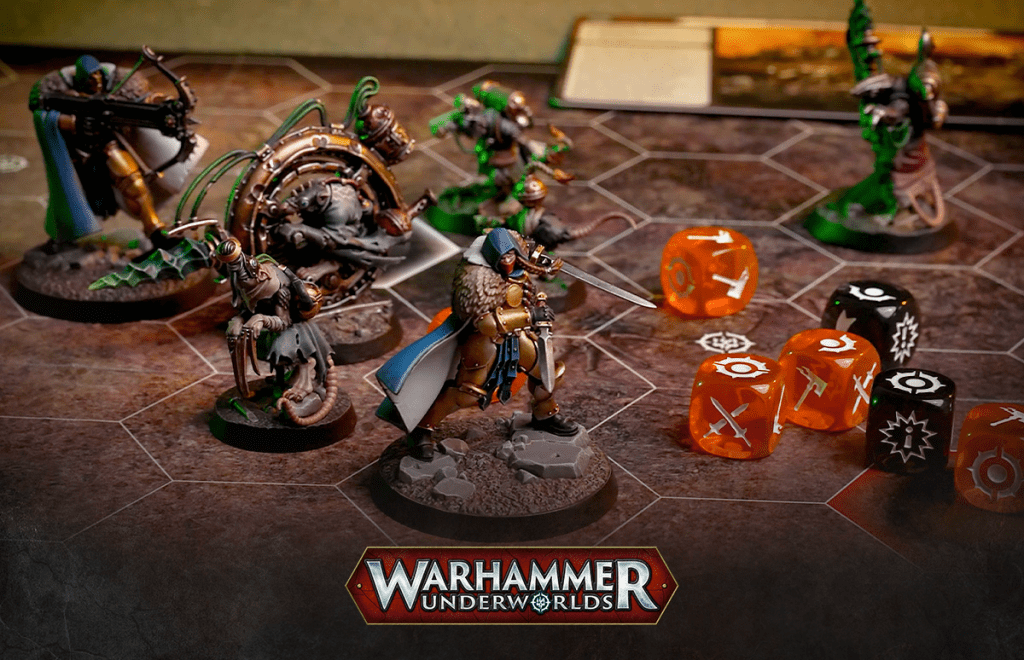
- After choosing a weapon, how many weapon abilities may you pick? What is a weapon ability?
- In what order and how may dice are rolled by the attacking player and the target player?
- What happens if a target has a stagger token? Multiple stagger tokens? (<–I don’ think this is directly in the rules, but can be reasoned)
- Define flanked and surrounded?
- What are the six common weapon abilities? What is a critical weapon ability and how is it represented?
- What do the weapon abilities cleave, ensnare, brutal, grievous, stagger, and grapple each do?
- How do you determine a successful attack and how much damage is inflicted?
- How does flanking and surrounded work? Who needs to be surrounded?
- When may you use “drive back” on a target? How does “drive back” work?
- What are the rules fo a push? Who decides where the push goes? Where cannot you not push? Is a push a move?
- When may you use “overrun” on a target? What is the overrun ability?
- When may you use “steadfast”on a target? What is the steadfast ability?
- What determines if a fighter is slain and what reward is gained for slaying an enemy fighter?
Power Step
- What are the four ‘actions’ (action is my word; playing a power card is considered one action; passing is also considered an action…so what are the remaining 2…)?
- Who goes first?
- When is an action resolved? Can you interrupt actions (e.g. such a playing an instant in MTG)?
- What is the delve ability? How does it work?
- How many times can one use delve in a Powerstep? What is the maximum number of delves a player could do in a battle round?
- What are the two sides of a feature token?
- What are the effect of a treasure token? A cover token (what does a cover-token provide)?
- What is the general purpose of Ploys? What is the general purpose of Upgrades? What are the differences?
- When can a Surge Ploy be played?
- Can Ploys persist beyond the moment they are played?
- What requirement must be met to play an upgrade? Where is an Upgrade placed once equipped?
- How many upgrades may a fighter receive? Can you put two upgrades on a fighter that both affect the fighter’s weapons?
End Phase
- What do you call the second part of a battle round?
- What are the five phases of an End Phase. Or instead, what happens in the End Phase in what order (feel free to group the discard and draw phases 3-5; feel free to add a token “removal phase”)?
- Which player resolves the end phase sequence first?
- After scoring Objective cards (and possibly gaining glory), what is the next step in the sequence?
- Describe discarding and drawing? How many can you discard? How many can you draw?
- Are discarded cards placed face up? Can you look through an opponents discarded cards? (pg. 17)
- Can a newly drawn Surge Objective card be scored immediately?
- What happens when you run out of cards?
Final End Phase
- Does eliminating all enemy fighters automatically win the game?
- What determines a major victory?
- What determines a minor victory? What is the order and conditions to you decide who wins a minor victory?
- When is the game a draw?
Extra Rules
- When a fighter is healed, how many damage tokens are removed? What happens if a fighter with no damage tokens is healed?
- What happens when a fighter enters a stagger hex?
- What is an occupied hex? What is an empty hex?
- What are the two sides of a feature token (repeat)?
- What does it mean for a fighter to be holding a treasure token? What benefit does a cover token provide in a Save roll? (repeat)
- What advantage does the flying runemark grant?
- How many fighters in a warband have the leader runemark?
- When is a fighter considered damaged? When is a fighter considered vulnerable? Undamaged?
- What happens to a fighter’s Bounty characteristic when they are Raised?
- What is a plot card? Which decks have plot cards? BONUS: How many decks can you choose that contain plot cards? How many plot cards can you use? (Check your work at the Rivals Deck Master List and enjoy the discussion on Plot Lock here)
Rule Clarification
- When a fighter must move or be pushed “away from” something, what must be true about each hex entered?
- If a fighter is driven back, what determines the valid destination hexes?
- Are diagonal or alternative paths allowed as long as the distance requirement is satisfied?
- What happens when both players can play Surge abilities at the same time? In what order do players play simultaneous Surge abilities?
- What do modifiers affect on cards? Are multiple modifiers applied together or separately? What is the minimum value a characteristic can normally be reduced to?
- Which type of modifier is applied first: numerical or set modifiers? If two set modifiers conflict, which one takes precedence?
- Can a re-rolled die normally be re-rolled again? When is the re-roll performed relative to the original roll?
Wrap
I’ll admit, even as a player who has been active weekly since launch and has played hundreds of games, I still didn’t know all of these things perfectly without looking them up. I know it’s homework, and boring or whatever, but if you take the time to go through this you might find a few for yourself.
This method of learning may not be for everyone, but if somebody in your local scene or friend group is just the right kind of nerd, hopefully you can send this their way and have a rules expert to rely on forevermore. Nerds of any stripe can still benefit from checking out the entries in the New Player Series.
Regardless of whether you’ve memorized the core rules or like to #DoItLive, I hope you enjoy Spending your Gory in the Underworlds!




Leave a Reply