
This article is a part of the Contender Series, the goal of which is to encourage players to begin participating in Organized Play events, attending tournaments and Grand Clashes, and overall up their competitive game to improve as players and ultimately win more often. While I am not personally some competitive ace taking home glass every weekend, I do have advice to help get newer players off the ground and set you on the path to success, and also can point you to better players than myself where you can get more focused advice when you’re at that stage. I will attempt to keep this article series ‘timeless’, so while I’ll reference specific warbands, cards, and mechanics occasionally, I want it to be relevant for years and so will try to refrain from focusing too much on today’s current competition climate. With those things said, let’s dive into this article’s main topic: Choosing haw many cards to include in your deck during Nemesis deckbuilding.
Articles in This Series:
Articles in This Series:
Warband Selection
Choosing a Deck/Pairing
Deckbuilding Overview
Evaluating Surge Objective Cards
Evaluating End Phase Objective Cards
Evaluating Ploys
Evaluating Upgrades
Deckbuilding: How Many Cards?
Opening Hand and The Mulligan
Board Choice and Orientation
Feature Token Placement
Fighter Placement
So You Won the Roll-Off – Do You Choose First or Second?
Practice
Event Format Considerations
Elites
Big Boys
Hordes (Coming Soon!)
Check out other tournament related articles:
Counterplay Series
Participating in Your First Tournament
What to Expect at your First Grand Clash
How to Run a Local Tournament
Building Your First Nemesis Deck
If you would like a more beginner oriented, less-competitive look at the basics of deckbuilding, here is a link to the ‘building your first nemesis deck’ article for Embergard
Assessing Card Count
Now that we have completed our review of card types in Nemesis deckbuilding, I wanted to return to the question of how many cards to take. In the prior segments, I included the following passage:
“You will note in the deckbuilding sections of the rulebook and format pages, you take a minimum of 20 power cards… nearly every player is going to find themselves at some point in their deckbuilding experience thinking ‘man, I really want to include both of these Ploys. How bad would it be if I took them both?’… if your goal is to win a competitive event, you usually should stick to 20 Power cards. The shortest explanation of this is that you draw up to 5 cards per phase, and there are three phases. Even if you played every card you drew every round (or discarded them at the end) and retained none between rounds, lost every roll-off and drew and extra card each time, you are only going to see 18 power cards across a game unless you spend activations drawing cards or include card drawing tech in your deck. Even with these, it’s a big ask to get through all 20 cards in three rounds, which means that generally speaking 15-30% or more of your power cards will not make it into your hand in a given game. Think about your best card, the one you would love to see every game, probably in the first round. The more cards you take, the less likely it is that you’ll draw that card early, if at all.”

I stand by that as a general rule of thumb. To date I have built two different decks for Grand Clash play (Las Vegas Open and Tacoma Open), and in both of those I took the minimum allowed. I did not feel in either instance that I was in need of more cards; in fact when testing my Emberwatch deck with 13 or 14 Objectives I was doing worse and improved my scoring and consistency when I reduced back to 12.
In other card games with variable deck sizes, nearly all guidance from expert players of those systems recommend the smallest possible deck for similar reasons. The concept of a ‘Tutor’ from Magic is an illustrative one – those cards do nothing more than allow you to draw another (though you often can search for a specific one). They are incredibly valuable, and even regular draw effects without the benefit of searching still hold high monetary value in secondary trading markets. The ability to ‘thin’ your Magic deck from 60 to effectively 59 cards is immense, and it’s only a fool who would take 61. With our deck sizes being so much smaller – 32 total, or 12 & 20, any card draw is proportionally that much more thinning and beneficial, and any excess card that much more burdensome. Or so the theory would suggest.

There do, of course, exist exceptions to many rules, and there are times when you want to deviate from this. Some of that is related to the unique system Underworlds offers us, and we have some capacity to make different decisions than what is ‘standard’ in other card games and still see competitive success, perhaps even more so than those decks that take the ‘normal’ smallest deck size.
Historical Exceptions
It is notable that at the World Championships of Warhammer in 2024, the entire top 8 all brought 13 or more Objective cards – this despite the fact that only 14 of the 46 competitors had Objective decks larger than the minimum. The composition therein can also vary from the ‘recommended’ maximum of 6 Surge Objectives; Daniele Gorini won the ‘24 Worlds despite only taking 5 surge objectives! Volomir, the winner of the single largest Second Edition tournament to date, won out over >120 opponents at Warhammer World by taking a whopping 15 Objective cards. It can be done, but it must be done thoughtfully.
Outside Opinions
I’m not the only person who has explored this topic, and I’d be negligent not to refer you to them as well.
Jake, the author of Starting Hex over on Goonhammer, covered his thoughts here.
Matt of Set The Tempo/Path to Glory did as well.
Let’s dive in to the two decks – Objective and Power – and explore when and how to exceed the minimum.
Objective Deck
Let’s begin by defining the benefits to including additional Objective cards. It’s somewhat straightforward – the more Objectives you take, the more Glory is available to you should you happen to score them. Glory is how you win the game, so shouldn’t you want more of it? If you are consistently scoring all 12 of your cards and finding that your Objective deck is empty midway through round 3, you may be tempted to add another card or three.
With very few exceptions (the incomparably talented Daniele aside), you are going to want to include the maximum 6 Surge objective cards. These can score mid-round, allowing you to draw into more cards, which you can then also score, in what’s called a Snowball Effect. They make Glory available faster, allowing you to apply Upgrades earlier, perform better, and score more cards. If you take fewer Surges, you’ll draw fewer Surges, score them less often, Snowball less often, and likely find yourself behind an opponent who has greater efficiency in this regard.
A concordant problem exists when you take more than 6 End Phase Objectives. Even if you took the maximum 6 Surges, they’ll be ‘watered down’ by adding more End Phases to the deck. Your odds of drawing a Surge at any given time is lower, and your odds of having 2 or 3 Surges to open the game and get your Snowball rolling is also lower. For this reason, some prefer to avoid overdoing End Phases. A thirteenth Objective is reasonable, especially if you are ‘scoring out’ your deck and don’t have a full brace of scorable cards going into the third End Phase. Just know that doing so will potentially lead to a reduction in the smoothness of your scoring – you could go from not having enough Objectives left at the end to having too many, and seeing a card get left in the draw pile at the end of the game.
I will also note that there is no good reason to exceed 15 total Objectives. This is the most that you should ever take if you’re interested in competitive success. In a perfect world, you score every one of your Surges mid-round every time, and go into each End Phase with three Objectives that you also score. That’s a maximum of 6 scored Surges and 9 scored End Phases, or 15 total. Even if everything goes marvelously right for you, you can’t possibly score more than 15 cards. You wouldn’t even be able to see more than 15 in a game unless you took the Focus action, and your gameplan should not revolve around that unless you’re the type of mad scientist I can’t begin to comprehend. When Volomir took 15 to Warhammer World, his approach was to discard any End Phase Objective he didn’t score in a given End Phase rather than holding onto it and reducing his efficiency.
When To Exceed 12 Objectives
So, now the real question: “When do I take 13 or more Objectives”? The answer will depend on your warband, pairing, and gameplan.
Gameplan
Strike – If you are playing a Strike/aggro approach, you can generally have lower glory count in your Objective cards, with less reliance on the scoring they offer. This is due to the fact you’ll be making up for that lack with higher than average Glory recovered in Bounty from slaying enemy fighters. Strike players may find they’re less concerned with having a ‘dead’ Objective card since they are less reliant on Objective-based Glory.
“Goal Card’ Orientation – If you are taking a difficult End Phase with a big payout, it can occasionally benefit you to take more cards. Some things, such as Trial of the Tempered from Edge of the Knife or Annihilation from Blazing Assault are things you’ll be working toward all game, but are substantially difficult or even impossible to score in the first round or two. Taking 13+ Objectives reduces the odds you’ll draw that goal card earlier than you want to see it/be able to score it. It also means, should you be so unfortunate as to draw it in Round 1, it won’t hurt as bad to discard it in the first End Phase and you’ll feel less pressure to hold onto it between rounds, ‘clogging up’ your Objective hand.
Pairing and Playstyle Harmony – If you’re going to be doing the same thing every round all game every game, you’re giving yourself the opportunity to score the cards that ask you to do those things no matter when they’re drawn. ‘Get on Token, Stay on Token’, for example, can score you a subset of Take and Hold type cards whether they’re in your hand or not. If enough of your cards ask you to do the same type of things, you’re more likely to score them in whatever order they arise. If you’re delving all game, you don’t mind as much exactly when your delve cards arrive, and if many of them are delve cards, you’re golden no matter what.
Pairing
Unreliable Surges – if your pairing has surges that aren’t all that solid and often are a challenge to score, you may not be as excited to draw into them. Including more End Phase cards reduces the odds of being asked to do those surges early, especially if they’re ones that require you to set things up a little more, or become easier with fewer fighters left on the board.
Easily Scorable End Phases – Some rivals decks, especially in the right pairing combination, have End Phase conditions that are much easier to meet than others. If you find your cards are all easily scorable, you’re much less likely to be stuck with one and stressing over whether to discard it. They’re also likelier to be lower 1-Glory cards, and so you might also find you need more of them available to you to keep pace.
Overlapping Scoring Conditions – see “Pairing and Playstyle Harmony above”. If you can score the majority of your cards with the same behaviors, the reliance on having a certain card at the ‘right time’ is less important, and so having less reliability in your Objective draw doesn’t hurt as much.
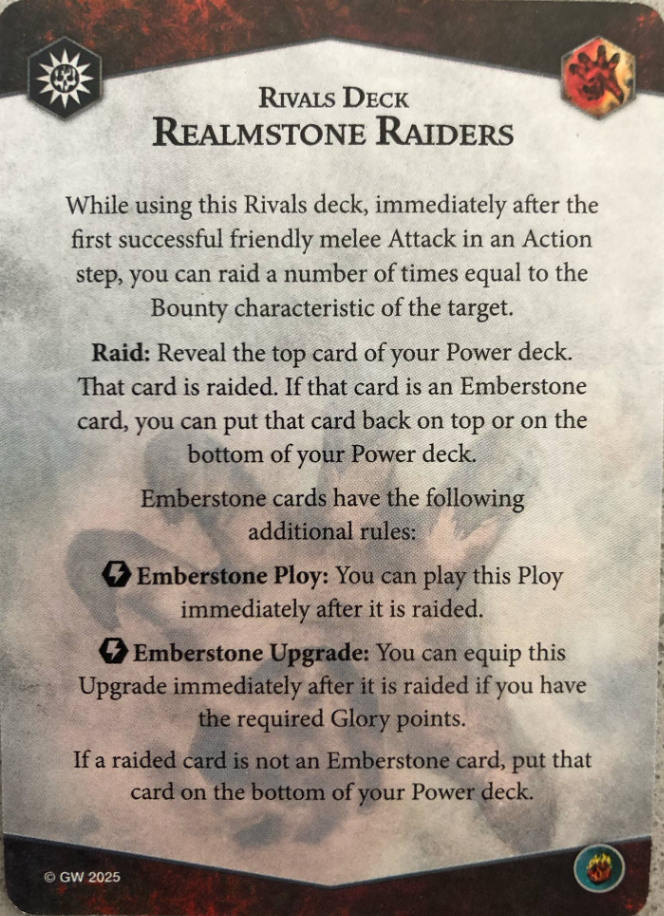
Objective Manipulation in the Power Deck – Realmstone Raiders contains the card Raider’s Premonition, which lets you take an Objective card out of your hand and dump it to the bottom of the deck, drawing another to replace it. If you’re pairing with RR, you can potentially have a ‘get out of jail free’ card available to you to put an unfavorable End Phase away for later. Should other decks be released with cards utilizing a similar mechanic, pairings that bring that option have more leeway to take extra End Phase cards.

Warband
Knives of the Crone – this warband is the only one that has an inbuilt mechanic for ‘getting away with’ additional Objective cards, namely the Foretold Wisdom result on the prophecy table. You’ll get to peek at what’s coming and decide if you like it or not. Taking more End phases is less risky here, as you can dodge them and draw Surges with more reliability than other warbands, and those ‘goal cards’ referenced earlier are much safer to include as well.
Should other warbands be released in the future with Objective manipulation in their warscrolls, they may also lend more favor to larger Objective decks.
Some warbands probably want to avoid extra cards in their Objective Deck more than most. Thundrik’s Profiteers, for example, inspire when they score a card (should their leader be on the field). The more cards you take, the less likely you’ll have surges, probably the less optimal the end phases you have will be, and the fewer early-game instances of scoring and therefore inspiration you’ll find. If other warband reference similar objective card/scoring related mechanics in the future, they may fall into a similar (air)boat.
Power Deck
“How many Power Cards should I take?”
I’ll begin by discussing the deckbuilding rules for Power decks: you must include a minimum of 20, no more than half of which can be Ploy cards. If you take an additional card, it would have to be an Upgrade. You could only take an 11th ploy if you also had an 11th Upgrade. Seeing as Ploys are more consistently available to you, much better to have early game, and can be applies much more situationally at better ‘speed’, the general approach is to never fall below 50% of your Power deck consisting of Ploys. Most competitive decks in the wild that use more than 20 cards do so in even numbered increments – 22, 24, or 26 Power cards.
I would recommend against taking more Upgrades than Ploys (or using an odd number of Power cards) unless many of them are zero glory cost and/or you have a special warband trait that allows for extra utilization of these Upgrades. To date, the only one that would reliably benefit from available Upgrades is Hexbane’s Hunters, as they can apply some ‘for free’ if they have slain fighters. Zondara’s Gravebreakers have a slight incentive to have Upgrades available for inspiring the two Destined fighters (and also have access to card draw, as will be described below). Even in these cases, I would strongly hesitate to take an Upgrade-heavy deck.
When To Exceed 20 Power Cards
Similarly this segment can also approach the real question: “When do I take more Power Cards”? The answer, again, will depend on your warband, pairing, and gameplan.
Gameplan
The only gameplan that would reasonably benefit from more cards in the power deck would be one that intends to take the Focus action relatively often. This would generally regarded as a bad game plan. For this reason, most people will not want to take extra Power cards. Already, you’re not going to see 2-5 of your power cards without extra card draw. If you’re not Focusing (and you should usually aim not to), more power cards only increase the odds of your favorite cards being in that un-drawn never-to-be-seen pile.
Playing in a best-of-three event and wanting to ‘keep them guessing’ is an extreme edge case that I wouldn’t recommend, but again, mad scientists do exist. If you’re willing to reduce the odds of seeing any given card in a game, taking more of them means you’ll be playing cards your opponent didn’t expect you to have or hasn’t seen yet this match more often. I doubt it will pay out in a higher win rate though.
Pairing
Access to Draw Tech – If your deck includes cards that let you draw or cycle more cards, then those pairings will have more capacity to take extra cards. Emberstone Sentinels has By the Numbers. Edge of the Knife has Power from Death. Realmstone Raiders has a handful of draw cards and has the Raid mechanic that lets you see more cards (though be VERY careful about having to dump them to the bottom).
Access to Zero-Cost Upgrades – These are like a Ploy-lite. You can play them more easily and so the ‘tax’ of having the have equal or more Upgrades hurts less. If your pairing lets you access many zero-cost Upgrades, you can take them and feel slightly less pain when you’re stocking up on strong Ploys.

Warband
Ylthari’s Guardians are one of the two best warbands for an expanded Power Deck. Their ‘plant a seed’ mechanic is wordy and labyrinthine (even for me, of all wordy people!), but gives you the ability to put Power cards on layaway. Ylthari’s players will see their whole power deck should they so choose/get lucky enough, and so can take higher than the maximum with much more confidence than the rest of us. Your average card will be ‘worse’, since you’re not just pickingthe 20 best, but you’ll have more. If you play Ylthari’s and consistently run out of Power cards, consider going to 22+.
Zondara’s Gravebreakers are the other warband where it is ‘ok’ to include extra cards in the Power Deck. They can’t draw cards unless friendly fighters are slain, but then can draw every power step if they’re delving with a minion. Early game their draw engine doesn’t do much, but played right you can rapidly pull your deck into your hand in round 2 or 3. I’m less keen on going above the maximum with them than I am with Ylthari, but you can certainly include it in your gameplan if you so desire and few would fault you for it.

Other warbands with less reliable and less potent warscroll draw-tech are Khagra’s Ravagers, Ephilim’s Pandaemonium, and The Headsmen’s Curse. These warbands can, in more limited and restricted ways, get extra cards across the game. I’d still very rarely go beyond the minimum 20 for these, but you’ll have more leeway to do so than most others.
Daggok’s Stab-Ladz have a vague desire for a larger card pool, since their warscroll gives them benefits based on the number of ploys they discard when using them. This means they want more ploys available to dump. Unfortunately, without ways to draw those extra ploys more reliably, they are unlikely to benefit from extra cards in their deck.
Hexbane’s Hunters as mentioned above can ‘get away with’ extra Upgrades to a very mild extent. I still wouldn’t angle for it.
Wrap
Hopefully I have shed some light on the questions regarding deck size in Underworlds, made a case for using the minimum, and offered you some useful thoughts on when and how to go beyond it. Until next time, I hope you enjoy Spending your Glory – maybe even Glory you got from extra Objectives and/or on those extra Upgrades you brought along.






Leave a Reply