
This article is another penned by Glenn, and it covers a ton of categories. We’ll slot this into New Player Series, Community Growth, and Custom Rules. The Trifecta!
If you were cool enough to receive a Warhammer Underworlds set for Christmas, or are even cooler and gave a set to somebody for Christmas, this will hopefully help you get your feet wet and test out the game with some simplified rules for your first few run-throughs. This is a similar approach to the old “Kidhammer” rules I cooked up years back, updated for Embergard/Spitewood/Second Edition.
Prepare to Descend into the Underworlds!

If you’ve been thinking of dipping your toe into the waters of Warhammer Underworlds, but are confused by its complexity, this article is for you. Or if you’re an Underworlds player looking to introduce someone who may be Underworlds-curious but might not be familiar with more complicated hobby games, this article is also for you. We’re going to explore an easy way to teach the game to quickly get familiar with the many pieces of the game.
Warhammer Underworlds is a fantastic game that blends accessible entry with mechanical variety that rewards repeat plays, experimentation, and exploration. Sitting at the intersection of board games, card games, and miniature skirmish wargames, it has elements of all three types of hobby games but doesn’t cleanly fit into any one category. The variety of elements the game contains can sometimes make it
intimidating to introduce new players – especially those who don’t have prior experience with games like miniature skirmish games.

Games Workshop, the publisher of Underworlds, has evolved the game and structured it in ways to try and make it more accessible. The starter product — currently the Warhammer Underworlds: Embergard Core Box – is a self-contained play experience for two players with no additional purchases necessary and a great deal of expandability already built in. The miniatures in the game, while still requiring assembly, are push-fit and molded in colored plastic so painting isn’t necessary (though it can clearly be a fun and exciting next step if you want to take your hobby in that direction). The rules have been revised multiple times, and the deck building aspects of the original game have been greatly simplified – either pick up a self-contained Rivals deck to pair with a warband, or smash together two Rivals decks in Nemesis format and be able to play at a competitive level.
Rules mastery can still be a challenge for new players, though, and that’s what this guide is for – we’re going to show you a step-by-step way to teach and learn the game that will ease you into Underworlds’ complexity. This guide is designed for the current player who is bringing a new player into the game, but it can also be used if you’re a self-starter teaching yourself the game.
The first thing to understand is that Underworlds consists of a collection of interacting rules mechanics that each contribute to the game. Individually they are fairly simple; the tremendous fun of mastering the game comes when all of the mechanics come together. There are seven rules systems the new player needs to understand to bring the game together, and we’re going to give you a step-by-step way
over three to five games to introduce them all. The rules systems are:
- Fighter cards
- Actions
- Feature token interactions
- Inspire mechanics
- Warscroll abilities
- Objective scoring and the Objective deck
- Ploys, Upgrades, and the Power deck
Assuming you’ve scanned the core rulebook and have picked out two warbands and two Rivals decks (see Core Rulebook, page 6*), you’re now going to set up and play a series of learning games with your opponent to build up to the full game. Back in early Underworlds, when the first “season” was called “Shadespire”, we called this way to introduce new players “Kidspire”. Maybe it needs a new name. (“Kindergard”?) but the technique isn’t just for kids – you can have a lot of fun playing even with the simplified rules steps outlined here!
Game 1: Fighters, actions, and basic features
For your first game, you’ll put the following rules into play.
- Review the gold “inspired side” fighter cards, and understand what each of the abilities means (Core Rulebook, page 4). Don’t worry about “Runemarks” yet – just basic movement, health, bounty, and attacks.
- Review the description of the board and the hex definitions (Core Rulebook, pages 3 and 15). Set up the board, and have the players alternate placing five treasure tokens treasure side up, then alternate placing fighters on starting hexes. (Core Rulebook, pages 3 and 7)
- Review the main actions or “Core Abilities”: Move, Attack, Charge, Guard. You’ll use these for this game. Review the combat rules in particular – that’s what this game will focus on. (Core Rulebook, pages 9-12, though skip “Weapon Abilities” on page 11 for now)
- Fighters will start Inspired (gold side up).
- Follow the roll-off rules in the rulebook and begin alternating Action Steps, moving, attacking, charging, and guarding. (Core Rulebook, page 8)
- You’ll score a fighter’s Bounty in Glory points for defeating an enemy fighter, and score one Glory if one of your fighters is holding a treasure token at the end of a round.
- That’s it! Highest glory total after three rounds of four activations each wins.
Game 2A: Inspiration, Warband Abilities, and Delving.

Once you’re comfortable with actions and combat you can (repeat Game 1’s format if you like), we’re going to introduce new mechanics in the next game This can be a stand-alone game, or if you’re a fast learner you can introduce the rules in Game 2B below.
For this game:
- Fighters will start the game Uninspired (silver card side up).
- Review the Inspiration rules (Core Rulebook, page 4). Then look at your warband’s Warscroll – the big card (page 4). You’ll use the rules and abilities in the orange (“Inspire Condition”) and grey text boxes on the left for this game. You will use these abilities and Inspire your fighters when the Inspire condition is met.
- Review the rules on Delving treasure tokens and Cover hexes (Core Rulebook, pages 13 and 15). In this game, each player may use a Delve action after an activation to flip a treasure token over to a cover token (or a cover token to a treasure token) and assign the occupying fighter a Stagger token. We’ll call this the Power Step for reasons that will become clear in the future. The activating player may Delve first, followed by the opposing player.
- Runemarks and weapon abilities now come into play. (Core Rulebook, page 11, right column)
- Now use the roll-off and setup rules from the rulebook to set up (Core Rulebook, pages 7-8).
- Play and score the game as in Game 1, with the additional abilities on the left side of the Warscroll and the Delve action in play.
Game 2B: Warscroll Abilities. (This can be combined with Game 2A if you’re ready to take it in one bite).
For this game:
- Review the abilities for your warband on the right side of the Warscroll in the white text box. These abilities are now active for the game (Core Rulebook, page 4).
- Play the game as you did game 2A, adding in these new abilities when appropriate. By this time, you should be comfortable with your fighter and warband abilities, actions, and combat, and can see how you score Glory by both combat and using treasure tokens. Now we’ll introduce the decks of cards over one or two more games.
Game 3A: Objectives and Objective Decks. (This can be combined with game 3B if you’re ready to take
on both decks at the same time.)
- Take out the Rivals decks you’ve chosen to pair with your warbands. The choice doesn’t matter much at this stage – if you find you don’t like a deck, feel free to swap to another for the next game. (Core Rulebook, page 5)
- Separate the 12 gold Objective cards from the 20 reddish-brown Power cards. Set the Power cards aside for Game 3B.
- Set up as per Game 2B, but now deal each player three Objective cards from their respective objective decks.
- You can take the Focus action now too. (Core Rulebook, page 9)
- Scoring now changes. You’ll still score Glory from the Bounty on a defeated fighter, but instead of scoring Glory for holding a treasure token at the end of a round, you’ll score Glory based on when you meet the conditions on an Objective card. Pay close attention – some Objective Cards are “Surge” objectives and score immediately (allowing you to draw a new Objective Card); other do not score until the end of a round or the end of the third round. Once you score an Objective Card it leaves your hand, and you’ll draw new cards at the end of each round up to your total of three in hand.
Game 3B: Ploys, Upgrades, and Power Cards.
You’re now ready to take on the full game. (This can be combined with game 3A if you’re ready to take
on both decks at the same time.)
- Pick up the 20-card Power decks you set aside in Game 3A. Now when you set up, each player will also draw five Power cards, giving you three Objective and five Power cards. (Core Rulebook, page 6)
- Review the rules on Power cards, Ploys, and Upgrades in the rulebook (Core Rulebook, page 13 & 14).
- After each activation, in the Power step you and your opponent will alternate playing Ploys, attaching Upgrades, or passing (playing no cards). When you both pass, move to the next player’s activation.
- Score from defeating fighters or objective cards as in Game 3A.
That’s it! Congratulations, you’re now playing Underworlds in its full Glory. If you like simpler rules, or are playing with players who still have trouble with the many rules mechanics, there’s nothing wrong with staying with one of these game modes and keeping the game more streamlined. The only thing that matters is that you’re having fun!
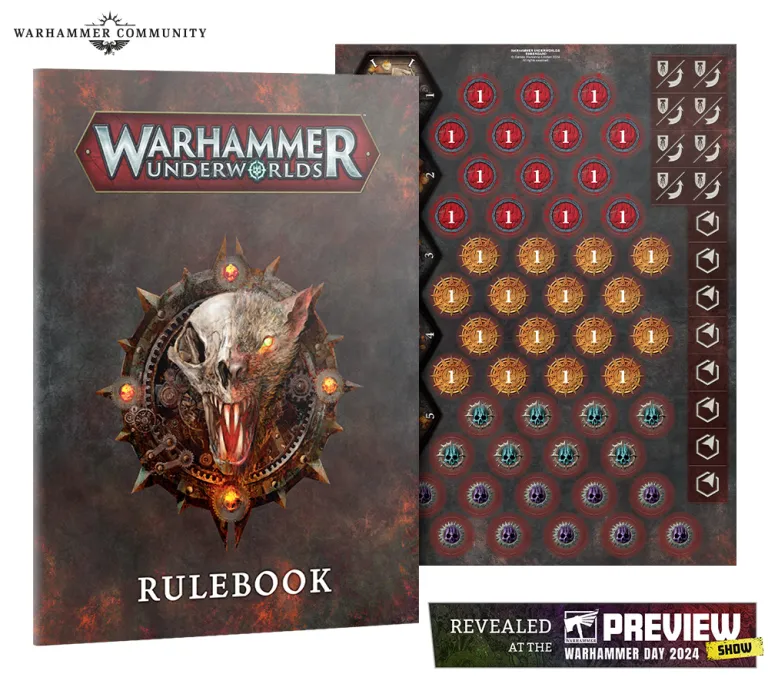
*Page numbers refer to the Warhammer Underworlds Core Rulebook as updated 15 October 2025, downloadable from Warhammmer Community at https://www.warhammer-community.com/en-gb/downloads/warhammer-underworlds/
Thanks Glenn, for another banger. What a hero!
Now that you’ve read through some introductory ways to play, why not check out the Spent Glory New Player’s Guide? Alternatively, if you’re coming back to second edition after a break sometime in the older game, here’s a Returning Player’s Guide.
However you like to play, and however slow you’re taking it, I hope you and yours enjoy Spending Glory in the Underworlds!






Leave a comment