
Today’s Article is a part of the New Player Series, which focuses on helping new players get more into the game and clear up some common questions when getting started out. If you’ve played a couple games of Rivals (or walked a new player though the process up to rivals) and now are ready to try your hand at the Nemesis format, this one’s for you. Nemesis opens up new avenues of play, a higher level of competition, and expands your pool of cards to work with, but might require you to develop a new skill: Deckbuilding.
If building your own Nemesis deck seems too much for you at the moment, there are plenty of places you can check for builds others have made. You can simply do what is called ‘net decking’, wherein you copy what somebody else has put together and don’t have to figure out what to include on your own. This is a fine place to start from, and once you’ve played a Nemesis deck a few times you might get a feel for what you like and what you would want to swap out – so it can certainly be a deckbuilding gateway. If you’re interested in net-decking, or simply want to get some inspiration while you build your own decks, check out The Battlemallet Nemesis Deck Repository or UnderworldsDB where you can see decks others have built as a starting point (or take one straight off the rack with a little five-finger discount, no judgement). I also have a more competitively focused article on choosing a pairing here.
This article is intended for use by Second Edition/Embergard players. If you’re looking for the First Edition ‘How to Build a Nemesis Deck’ article, it can be found here, along with this ‘how to choose a pairing’ guide for 1e.
Want more like this, at a deeper level? Check out the Contender Series!
Click HERE for a list of every warband in Second Edition, as well as suggested deck pairings
General Nemesis Theory
Choosing your Warband and Decks

In Nemesis you will want to pick a warband and pair it with two universal Rivals decks, rather than one like you would in Rivals. An important skill that’s going to affect your success is choosing a complimentary deck to go with your warband, and a second deck that compliments the first. Some Universal decks such as those found in the Embergard Core Box can work relatively well with most warbands. Others, however, might not work very well depending on what you pair them with. For example, don’t pick Reckless Fury if your warband has too many fighters to reliably hand out enough charge tokens, you probably want to skip Wrack and Ruin if your fighters are too soft or low health to handle the damage you’ll have to take/risks you’ll have to put them in to score, and Edge of the Knife probably isn’t for you if you don’t have any Tempered fighters who start with 2 or fewer wounds..
There is a lot that goes in to choosing a warband and the decks to go with it, but for your first few Nemesis games you can likely choose whatever you’re comfortable with and develop from there. You could ostensibly choose decks that match your warbands assigned style, such as taking two Strike decks with a Strike warband, but that isn’t always necessary (or even the strongest choice in some cases). Another option is to take a peek at the Nemesis Statistics Project and see what warband and deck combos have higher win percentages – while this isn’t perfect data and doesn’t capture the entirety of what went into a win or a loss, it can be an informative starting point if you have no clue about what pairing might work best for you.
Components of a Deck and What to Consider

Once you’ve chosen your warband and your two Rivals decks, it’s time to start smashing them together. People have different approaches to how to begin, so I’ll simply offer mine and you can tinker away as you see fit. The only hard rules are that you must have at least 12 objective cards, no more than 6 of which can be Surge (score immediately). You must have at least 20 power cards, and can’t have more gambit cards than upgrades. In practice, this usually comes down to picking 6 Surge Objectives, 6 End Phase Objectives, 10 Ploys, and 10 Upgrades. There is a lot of theory as to why this is the smoothest and most consistent/competitive card selection, and debate about when to deviate from it, but suffice it for this beginner article that this is probably the card mix you should aim for to start. The other thing you’ll need to keep in mind are the Forsaken and Restricted card list, which can be found in the Nemesis Rules Document – you can only have a limited number of Restricted cards, and cannot take any Forsaken cards in a valid Nemesis deck.
I usually pick objectives first because it sets the tone for what I’m ‘trying to do’ and then grab power cards that support that plan. Others may choose the best power cards and then try to choose objectives that those can score but this may be a little more difficult (you may include more Guard/’Can’t Be Driven Back/Pushed’ cards than you otherwise would if you know you’ll need to stay on a Feature Token or in a certain territory/position, for instance)
While putting together your Objective deck, look for objectives that support the warband’s playstyle and are consistent to score. Everybody has a different risk tolerance, but it usually feels better (and will serve you better across a multi-game match or event) to score 1 glory easily and often rather than try and fail for a big 3 glory payout most games.
After you’ve chosen your Objective deck, it’s time to move on to Power cards – make sure when you select these that they both appear to be useful and powerful in their own right, bit they also support your gameplan that you designed when picking your Objectives. A deck that is focusing on getting kills in enemy territory might enjoy upgrades that hand out Grievous, or gambits that allow for rerolls/+ dice. An Objective deck that is focused on holding feature tokens might prefer defensive upgrades, or ploys that put their fighters on guard, among other options.
Let’s Build a Deck Together!
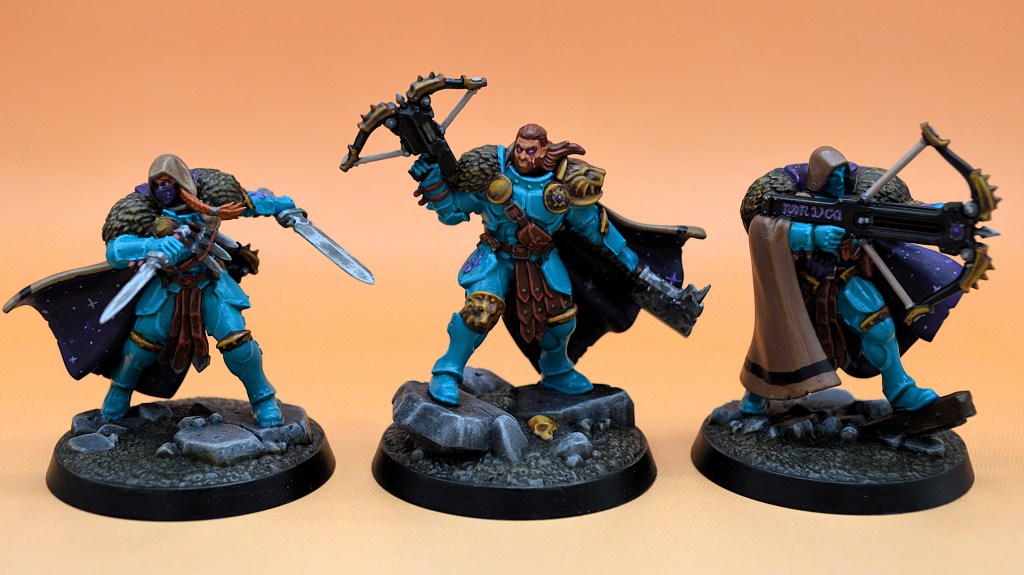
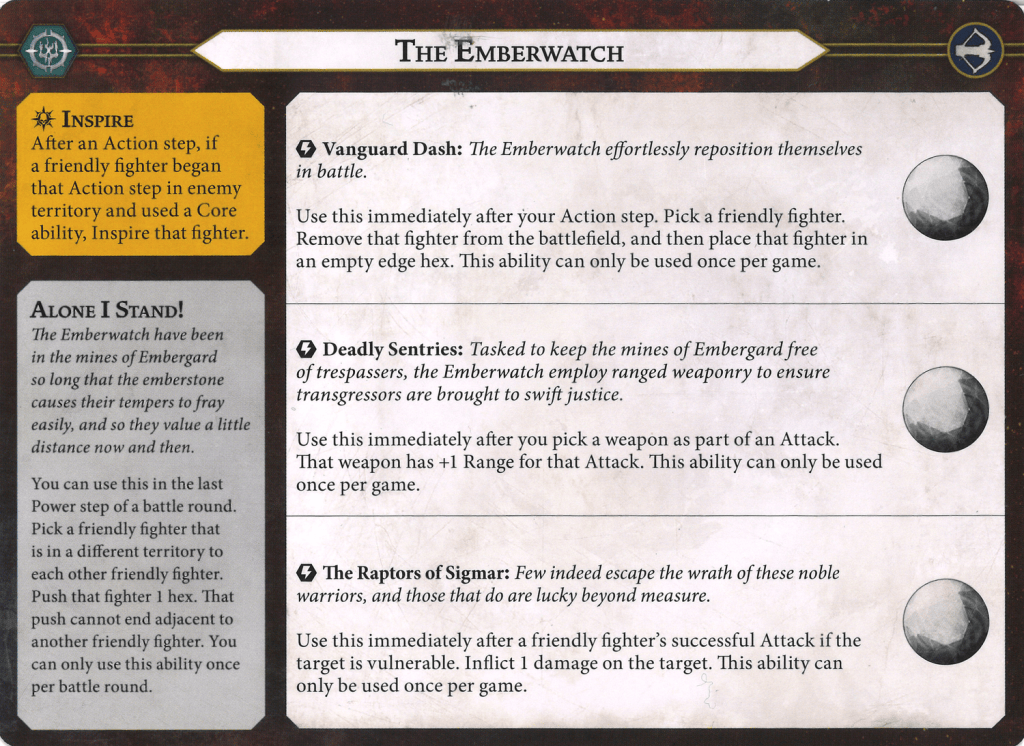
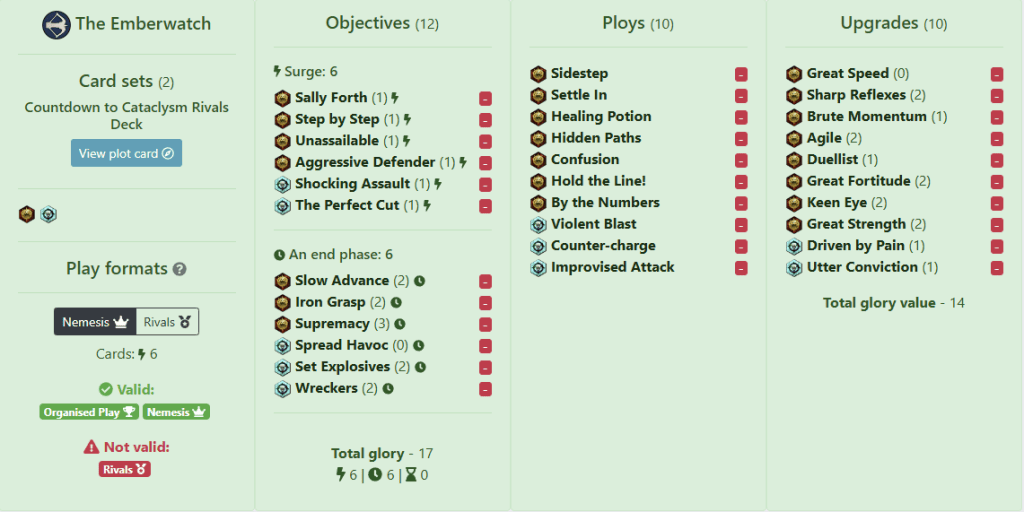
To illustrate the above general principles, let’s make a deck ‘live’ on this page. From the Embergard Core Box, we will try out The Emberwatch with both the Emberstone Sentinels and Countdown to Cataclysm Decks. This should allow us to make a focused Nemesis combination that wants us to hold Treasure Tokens in both Neutral and Enemy Territory while doing some damage – the Warscroll for the Emberwatch encourages us to invade Enemy Territory and provides tools for getting onto Feature Tokens while there, as well as making attacks from the tokens and not having to walk off of them to engage. You could think of this as an aggressive Take and Hold gameplan, which somewhat aligns with the warband’s Flex designation – despite neither Rivals Deck being classed as Flex by itself.


Objective Cards
Let’s start by dividing Objective decks into surges and end phases. Let’s aim for 6 surges. Then fill out with 6 end phase that support that.
Starting with Emberstone Sentinels Surges I’ll grab:
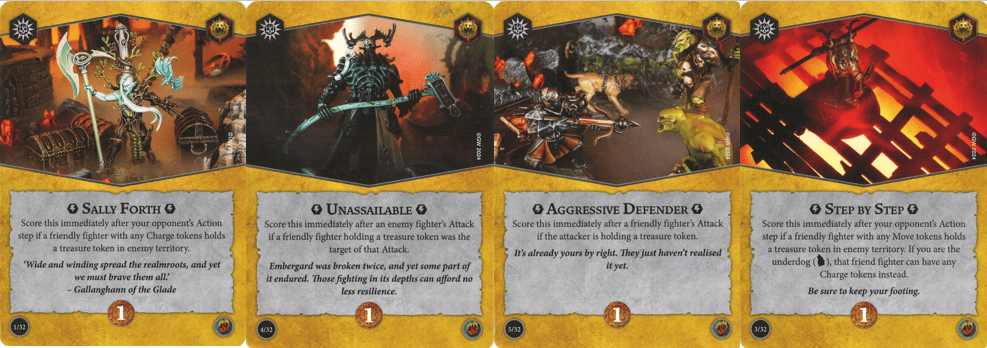
Sally Forth since I want to be making charges in enemy territory,
Unassailable since your chances of winning a defense roll on 2 shield are decent,
Aggressive Defender since again I want to be making charges/attacks on tokens, and
Step by Step since enemy territory tokes are the goal – making a move action for one glory can still be worth it, and there’s the chance I’m the underdog and get to score on a charge.
Looking at the Countdown to Cataclysm surges, I’ll grab:
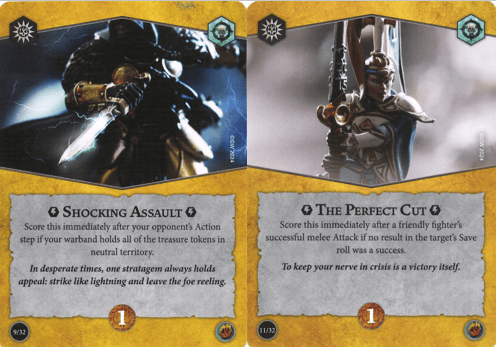
Shocking Assault (definitely doable if there’s only one token in neutral territory) and
The Perfect Cut – Ideally I’m attacking 10-12 times per game and they’ll roll no successes on some of those. I might want a few cards that confer Cleave or Ensnare to help out.
I also considered Too Close for Comfort, which could definitely take the place of either Cataclysm surge or Step by Step as those are my weaker options. Overwhelming Force is tempting but you would need power card support since only inspired Farasa naturally throws four dice. Collateral Damage sort of depends on me losing fighters or being the Underdog, and might get swapped in depending on how the first few practice games go.
Now it’s on to the end phase cards. Again starting with Emberstone Sentinels End Phases I’ll take:
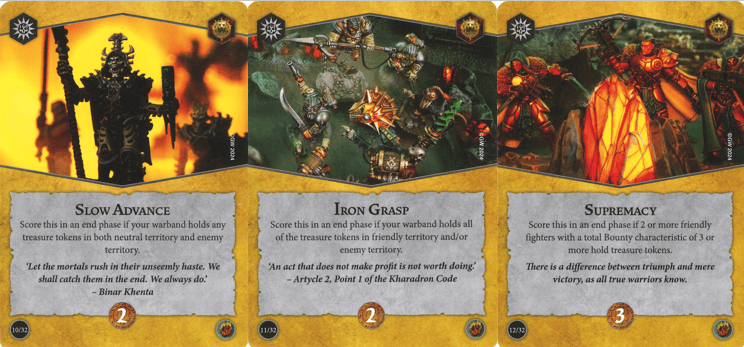
Slow Advance, Iron Grasp, and Supremacy since since I already want to hold tokens in both neutral and enemy territory from my Surge package, hold at least two, and all three of these cards have higher glory rewards.
On the Countdown to Cataclysm front, I’m bringing along:
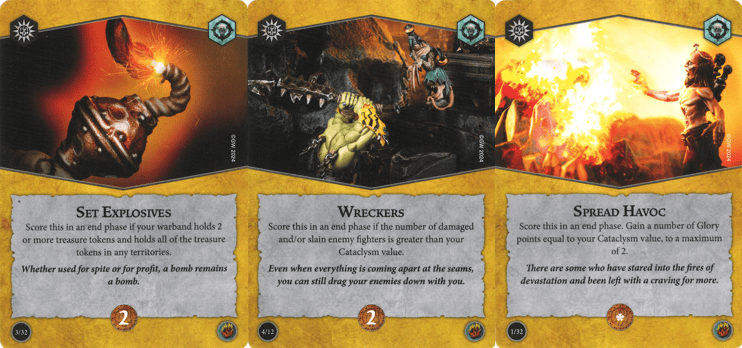
Set Explosives as it has a lot of overlap with my other goals,
Wreckers as I’ll be able to damage multiple fighters with my ranged attacks across the warband, and
Spread Havoc as it auto-scores for one and could score up to 2.
This deck has a possible total of 19 glory (assuming Spread Havoc scores for 2), which is pretty greedy, and if I lose two of my three fighters too early I’m in a lot of trouble. The hope will be that I can keep two fighters alive and hold a token in both neutral enemy territories, and hopefully have only 1-2 tokens in enemy territory and 1 in neutral territory during placement to give me the best chance of scoring out my cards. This might be too risky of a gameplan, but with smart play and a good set of Power cards, we might just be able to make it happen. The Emberwatch do also have a nice “Alone I Stand” push on their warscroll to help us sneak onto the tokens at the last minute if we line up our positioning well.
Another thing to notice is that I have taken 7 Emberstone and 5 Cataclysm objectives – you do not need to make a nemesis deck a perfect 50/50! As you’ll see in the power cards, I’ll dip even harder into Emberstone as that’s going to be the ‘primary’ deck or ‘The A Deck’ for this build as I put these cards together. You can craft a Nemesis deck to any ratio of your liking: perfectly balanced between the two halves, nearly all from one deck with a sprinkle of cards from the other (The Secondary/B Deck), and anything in between.
Gambit Cards
Let’s more onto Power cards! Let’s grab some Gambits. Starting again with Emberstone Sentinels, I’ll snag:
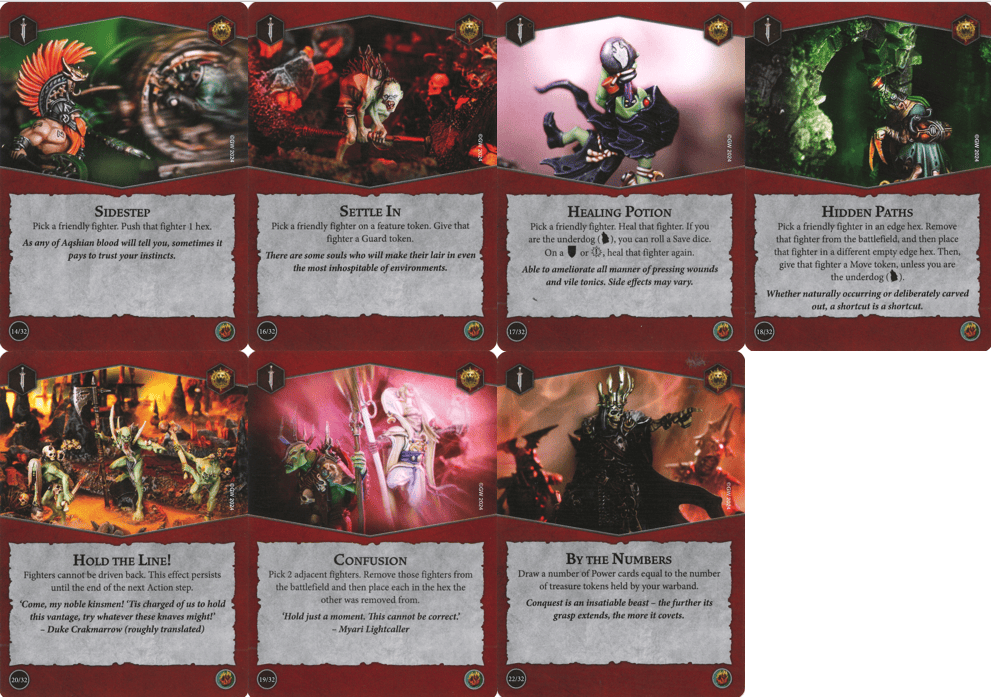
Sidestep (always useful, especially for Take and Hold),
Settle in (which will help me stay on the tokens I grab),
Healing Potion (to protect my fighters – I need to keep 2 alive, remember)
Hidden Paths (to get into enemy territory and inspire more readily)
Hold the Line (to stay on tokens/in territories when I need to)
Confusion (to steal a token a bad guy is holding)
By the Numbers (to get to my other good cards more quickly, as long as I’m holding at least one treasure)
From Countdown, I want:
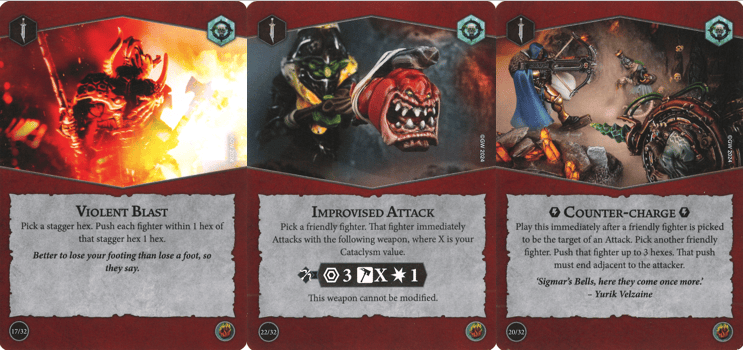
Violent Blast (helps me get into/out of the fight, onto a token, or a bad guy off a token, or both!)
Improvised Attack (an extra attack that can more importantly help me get a driveback to knock somebody off a token or away from me so I can stay on one)
Counter Charge (to get Flanked on defense, but also to get into a territory and possibly even onto a token more easily)
I also looked longingly at several cards in Cataclysm like the ping cards Sudden Collapse and Sunder the Realm, as well as Raging Tremors, but decided to leave them at home. While they’re potent cards in their own right, they don’t help me get on tokens and stay on tokens as reliably, which is how I score my Objective cards and actually win the game.
Upgrades
Rounding out the power deck, let’s look at what 10 upgrades support our scoring plan. Beginning as we have been with Emberstone Sentinels:
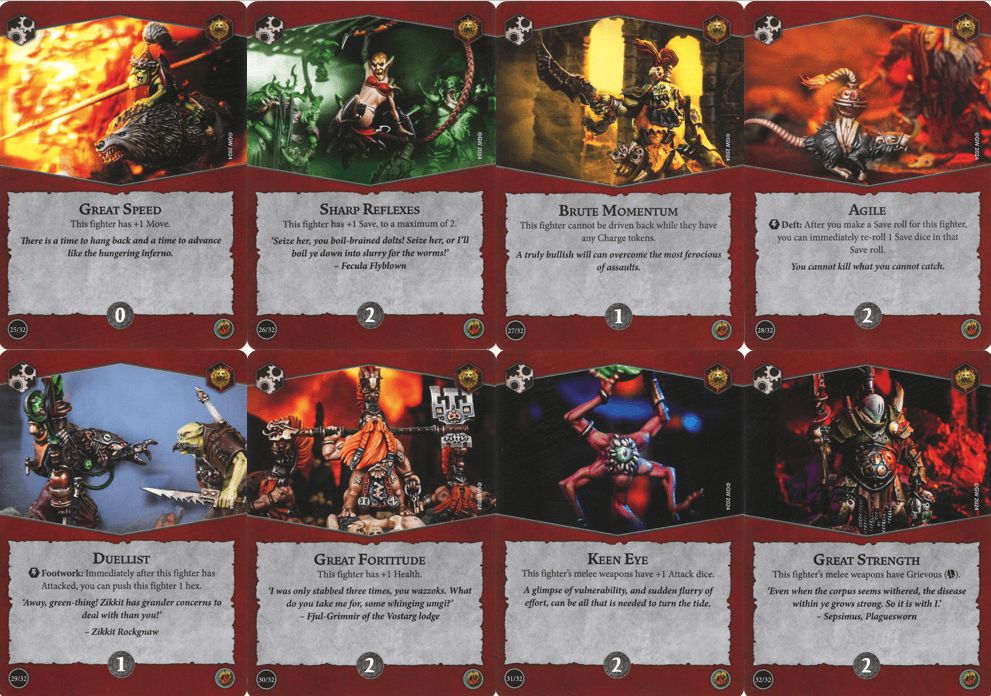
Great Speed (makes reaching tokens easier, and it’s free – costing zero glory to equip)
Sharp Reflexes (helps you survive early game, and good all game on Yurik)
Brute Momentum (helps you stay on tokens if you’ve charged onto them, which I plan to)
Agile (helps you survive attacks and dead fighter’s can’t hold tokens)
Duelist (helps you get onto a token after a failed overrun, or charge off and then step back on to a token if needed)
Great Fortitude (staying alive!)
Keen Eye (never hurts to hit more often, shame it’s melee only)
Great Strength (never hurts to hit harder often, and again shame it’s melee only)
And from Cataclysm:
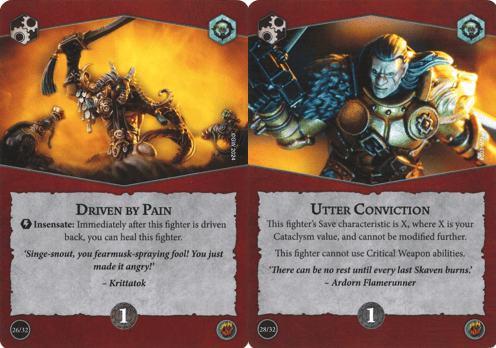
Driven by Pain (helps discourage being driven back, and if they do choose to do so might keep the fighter alive a bit longer)
Utter Conviction (potentially gets a fighter up to 3 or 4 shield, and Yurik can benefit much earlier)
While I would love to take Great Fortitude from Countdown to Cataclysm, I already chose the one from Emberstone Sentinels, and you can’t have more than one copy of the same named card in a single Nemesis deck. Inescapable Grasp could be nice if you know you’re fighting lots of Dodge warbands, and Visions of Ruin could potentially make me much faster which might be worth the stagger token it gives you. After a few test games these are all candidates to swap in.
Now we have a 32 card Nemesis deck! After we play a game or two with it we may want to go back and make some changes – maybe a card doesn’t score as consistently as we had hoped, a ploy’s conditions just don’t arise often enough, or we find that we never purchase an upgrade when it’s in our hand. It’s time to make some swaps! If you want to see the deck I have cobbled together in a more cohesive or visual way, here it is in Underworlds DB
Conclusion

While the above framework is simply my approach to building a nemesis deck, it’s a good branching off point for you to build your own decks. And I hope it’s shown you that putting your own deck together isn’t all that difficult! Choose a warband and two rivals decks to pair with it, decide on your overall goal, choose objectives to support that goal, and then power cards to help you score those objectives. Let me know what you think, and get out there and build some decks.
Should any of you decide to give the above deck a spin, let me know how it goes! It might not be the world’s most competitive deck, but It’s a straightforward gameplan and I hope was able to illustrate how you go about choosing cards – remembering that you want your power deck to support your objectives wherever possible. If you want more like this to level up your game even further, check out the Contender Series! Until next time, I hope you enjoy spending your glory in the Nemesis format.




 Spent Glory
Leave a comment